Ravenclaw House History & Lore: Founding, Famous Alumni, and Secrets Revealed
Ravenclaw – the Hogwarts house of wit, wisdom, and creativity – has a rich history brimming with intriguing characters and enduring legends. In this comprehensive guide, we explore Ravenclaw’s founding by the brilliant Rowena Ravenclaw, the symbols and values that define the house, notable Ravenclaw alumni through the ages, and the myths and lore (from the Grey Lady ghost to the lost diadem) that continue to fascinate Harry Potter fans.
Ravenclaw – the Hogwarts house of wit, wisdom, and creativity – has a rich history brimming with intriguing characters and enduring legends. In this comprehensive guide, we explore Ravenclaw’s founding by the brilliant Rowena Ravenclaw, the symbols and values that define the house, notable Ravenclaw alumni through the ages, and the myths and lore (from the Grey Lady ghost to the lost diadem) that continue to fascinate Harry Potter fans. By the end, you’ll have a deeper appreciation for Hogwarts’ most enigmatic house and its legacy in the wizarding world.
Founding of Ravenclaw House and Rowena Ravenclaw’s Legacy

Over a millennium ago, Rowena Ravenclaw – a gifted Scottish witch – helped found Hogwarts School of Witchcraft and Wizardry alongside Godric Gryffindor, Helga Hufflepuff, and Salazar Slytherin. Renowned for her brilliant intellect and creativity, Rowena was often described as “the most brilliant witch of her time.” She hailed from “the glens of Scotland” and either bore or married into the Ravenclaw family.
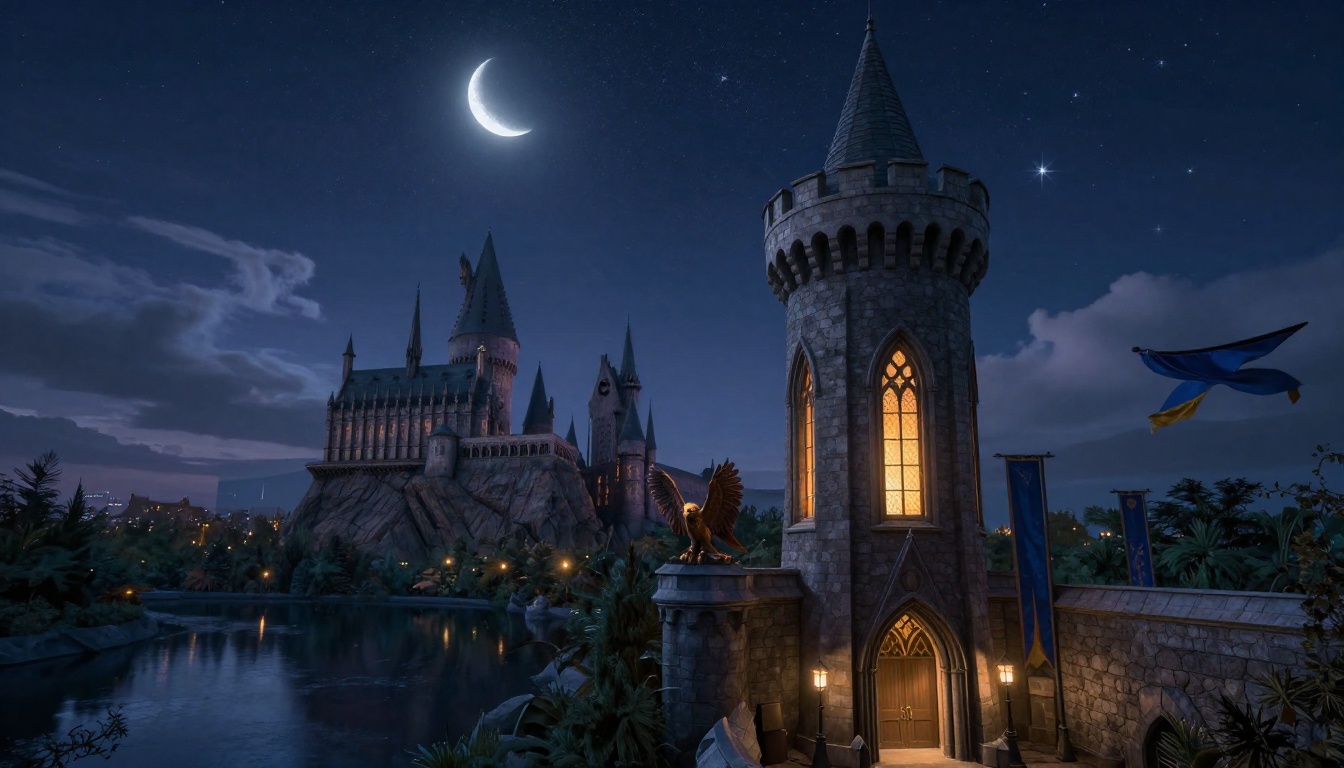
According to legend, it was Rowena who chose Hogwarts’ location and name, after dreaming of a warty hog leading her to a cliff by a lake. She is even credited with devising Hogwarts’ ever-changing floor plan (the magical moving staircases and shifting architecture) – a testament to her ingenuity.
Rowena Ravenclaw’s house values were centered on intelligence and wisdom. When selecting students for her house, she “valued a sharp mind, wisdom, creativity, and cleverness” above all. Thus, Ravenclaw House became known for students who prized learning and wit. Rowena’s close friend Helga Hufflepuff shared these inclusive ideals, and together with Godric they welcomed magical children from all backgrounds. In fact, when Salazar Slytherin later argued that Muggle-borns should be barred from Hogwarts, Rowena and the other founders staunchly opposed him. Ironically, a large percentage of Ravenclaw students were Muggle-born, reflecting Rowena’s belief that magical talent could arise from any lineage. This rift led Slytherin to leave the school, but Hogwarts endured – guided by the wisdom and tolerance of founders like Ravenclaw.
Rowena’s Diadem and “Wit Beyond Measure”
As a symbol of her wisdom, Rowena Ravenclaw owned a famed circlet known as Ravenclaw’s diadem, said to enhance the wearer’s intelligence. Inscribed upon it was the house motto: “Wit beyond measure is man’s greatest treasure.” This credo, attributed to Rowena herself, encapsulates Ravenclaw’s ethos.
The diadem was lost during Rowena’s lifetime, giving rise to one of Hogwarts’ great mysteries. Even so, the ideal of wisdom as the ultimate treasure lived on. The Sorting Hat’s song for new students likewise praises “wise old Ravenclaw” for those “with a ready mind, where those of wit and learning will always find their kind.” To this day, Ravenclaw’s reputation for scholarly excellence and cleverness stems from Rowena’s enduring legacy.
The Tragic Legend of Helena Ravenclaw (The Grey Lady)
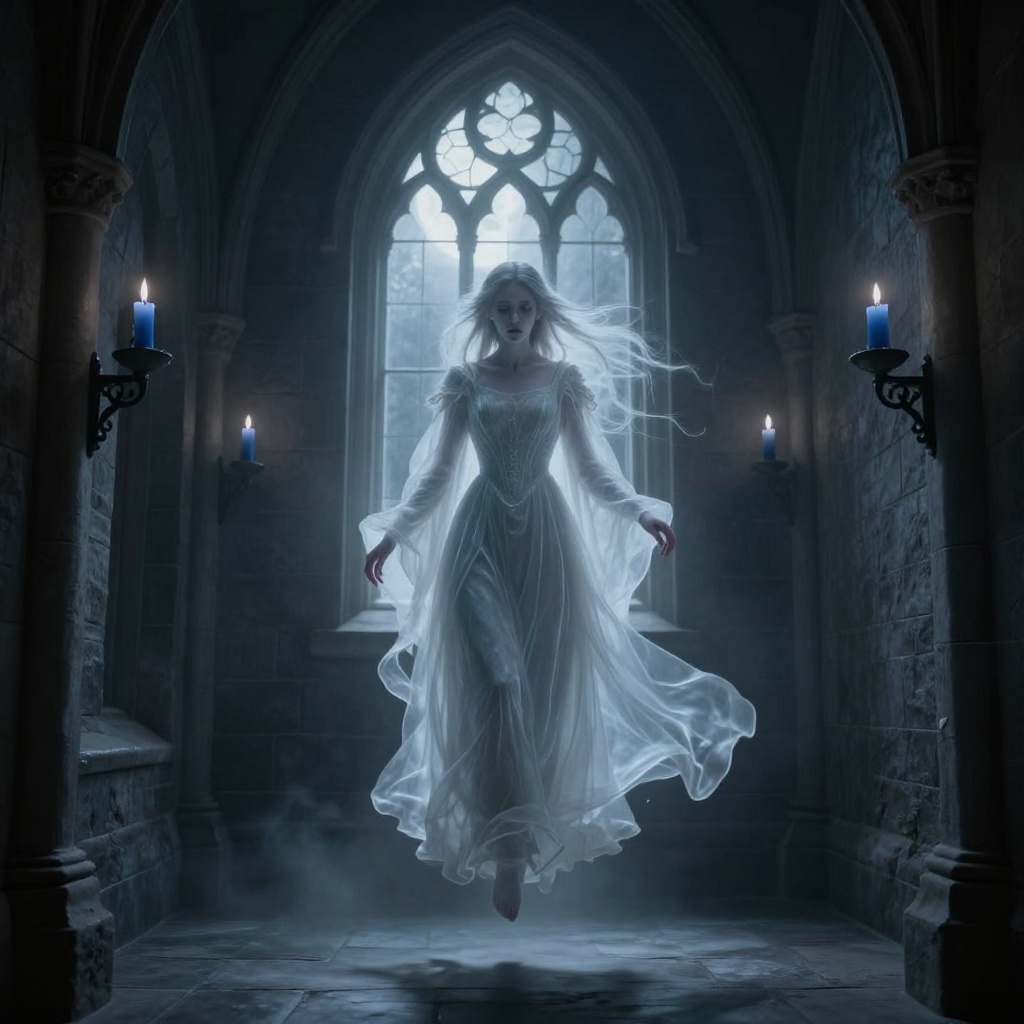
One of the most haunting tales in Ravenclaw’s history is that of Helena Ravenclaw, Rowena’s only daughter – better known in Hogwarts as “The Grey Lady.” Jealous of her mother’s fame and intellect, Helena stole Rowena’s enchanted diadem in hopes of using its wisdom-enhancing power to outshine her. She fled far from Scotland to Albania, hiding the diadem in a hollow tree. Ashamed of this betrayal, Rowena kept the theft secret and refused to let anyone know the relic was missing.
Despite her hurt, Rowena’s dying wish was to see her daughter one last time. Fatally ill and heartbroken (legend says she died of a “broken heart” over Helena’s absence), Rowena sent a trusted knight – the Baron, who loved Helena unrequitedly – to find her. The Baron tracked Helena to an Albanian forest; when she refused to return, he flew into a rage and tragically stabbed her to death, then, horrified by his own deed, took his own life. These restless souls returned to Hogwarts as ghosts: Helena became the Grey Lady, the silent and sorrowful Ravenclaw house ghost, and the Baron (stained with silver blood) became the Bloody Baron of Slytherin. Thus, two Hogwarts house ghosts are forever linked by this dark incident.
Helena Ravenclaw’s ghostly presence remained an enigma for centuries. Quiet and enigmatic, she rarely spoke to students. It was only in Harry Potter and the Deathly Hallows that Harry (and readers) learn the Grey Lady’s identity and secret. Helena admitted that she had hidden her mother’s diadem in Albania long ago, and that Tom Riddle (the young Voldemort) had charmed her into revealing its location decades earlier. Riddle retrieved the diadem and later corrupted it into one of his Horcruxes – thus defiling “both it and the memory of Ravenclaw.” Ironically, the lost diadem of Ravenclaw, born from Helena’s jealousy, became a key to Voldemort’s downfall when Harry helped destroy it centuries later.
The Grey Lady herself is characterized by sadness and intellect. J.K. Rowling once described Helena as “a highly intellectual young lady” with strong scholarly interests, who “never found true love as she never found a man up to her standards.” This poignant detail adds depth to the Grey Lady’s story – in life, her lofty ideals left her isolated, and in death she kept her silence until the moment her knowledge was vitally needed. For Ravenclaw students, Helena’s tale is a cautionary legend about ambition and remorse, often retold in hushed tones in the common room.
Ravenclaw House Symbols: Colors, Mascot, and Motto
Every Hogwarts house is steeped in symbolism, and Ravenclaw is no exception. The official Ravenclaw colors are blue and bronze, chosen to represent the element of air (to which Ravenclaw corresponds). Blue like the sky and bronze like eagle feathers, these colors adorn the house’s décor and uniforms. (Notably, the Harry Potter films portrayed Ravenclaw with blue and silver, but in the original books and lore it’s blue and bronze.) The Ravenclaw points hourglass in the Entrance Hall is filled with blue sapphires to mark the house’s earned points.
The house emblematic animal is the eagle, a symbol of broad vision and intellect soaring to great heights. Despite the name “Ravenclaw,” the mascot is not actually a raven – an oft-confused fact among fans. The term Ravenclaw comes from Rowena’s surname, but in heraldry the eagle was chosen to embody the house’s values. An eagle “soars where others cannot climb,” representing the aspiration to wisdom and the element of air. (It’s a fun irony that ravens do appear in the nearby Tower of London in Muggle history, but at Hogwarts it’s the eagle that reigns in Ravenclaw Tower.)
Professor Filius Flitwick, Head of Ravenclaw House, embodied many Ravenclaw traits: intelligent, creative, and a master of Charms. The house colors reflect the sky and eagle feathers, tying into Ravenclaw’s association with the element of air.
Ravenclaw’s official motto – “Wit beyond measure is man’s greatest treasure” – originates from Rowena Ravenclaw and is etched onto her lost diadem. These words capture the house philosophy that mental agility and wisdom are worth more than any material wealth. Students proudly recite this motto, and it often appears on Ravenclaw scarves, banners, and memorabilia. The Sorting Hat’s songs over the years also emphasize Ravenclaw’s focus on wit, learning, and wisdom, underscoring that those who value knowledge will find their home in this house.
What It Means to Be a Ravenclaw: Traits and Values
Ravenclaw House prides itself on intellectual virtues. Its members are characterized by wit, curiosity, and a love of learning. Many Ravenclaws are academically gifted and diligent students, often achieving top exam scores. They tend to be original thinkers who delight in puzzles or engaging with “different types of magic that other houses might shun.” It’s not uncommon to find Ravenclaws practicing esoteric spells or buried in obscure books, pursuing knowledge for its own sake.
However, the Ravenclaw temperament is far from one-dimensional. In fact, one hallmark of the house is individuality. Ravenclaws are known to “pride themselves on being original in their ideas and methods.” This culture of acceptance means that Ravenclaw has produced some delightfully eccentric personalities. For example, Luna Lovegood – with her quirky belief in magical creatures like Nargles and Crumple-Horned Snorkacks – was initially teased for her oddities, yet she epitomized Ravenclaw’s open-minded creativity and ultimately became celebrated for her unique perspective. Another Ravenclaw, Uric the Oddball, is a medieval legend famous for wearing a jellyfish as a hat and keeping fifty pet Augureys. Clearly, Ravenclaws have never been afraid to march to their own beat.
That said, a strong academic competitive streak can exist in Ravenclaw house. According to one (perhaps biased) Slytherin prefect, Ravenclaws “were so competitive when it came to academic success that they were known to backstab each other” in pursuit of top marks. And a Hufflepuff noted that Ravenclaws were sometimes so proud of famous intelligent witches/wizards that they’d claim them as Ravenclaw alumni even when they weren’t – for instance, the well-known arithmancer Bridget Wenlock was actually a Hufflepuff, though a Ravenclaw prefect insisted otherwise in a duel! These anecdotes show that Ravenclaws can be prideful about intellect. House members revel in brainteasers, debates, and academic glory, and they love to celebrate their “brainiacs.”
At their best, though, Ravenclaws form a supportive community of scholars. Inside the house, they’re known for “being welcoming and encouraging of creativity, eccentricity, and individuality.” Older students often mentor younger ones in subjects like Charms or Potions. Study groups flourish, and there’s usually someone willing to help if you’re stumped by a tricky riddle (after all, helping solve riddles is practically a house pastime!). Many Ravenclaws also side with justice and good; for example, during heated school rivalries, Ravenclaw generally allies with Gryffindor against any Slytherin malfeasance. In summary, to be a Ravenclaw is to value knowledge in all its forms – logical or abstract, scientific or artistic – and to use that knowledge in inventive ways, all while celebrating the freedom to be oneself.
Do you have a ready mind? If wit and wisdom are what you value most, you might just be a Ravenclaw — Take the Sorting Hat Quiz to find out.
Inside Ravenclaw Tower: The Common Room
One of the most breathtaking locations in Hogwarts is the Ravenclaw common room, perched atop Ravenclaw Tower. It is often described as the airiest room in the castle. Students reach it by climbing a tight spiral staircase that ascends to the tower’s peak. Uniquely, there is no doorknob or password at Ravenclaw’s entrance – instead, a large bronze knocker in the shape of an eagle poses a new riddle each time you seek entry. You must answer the riddle correctly to be admitted; answer wrongly, and you’ll have to wait for someone more clever to come along! This practice reflects Rowena Ravenclaw’s belief in learning and wit. As one student notes, using riddles is ultimately safer than passwords, since “most wizards and witches do not have much sense of logic,” which means intruders are easily stumped unless they have the wit of a Ravenclaw. (Indeed, even Professor McGonagall – a former Hatstall who almost was a Ravenclaw – had no trouble answering the eagle’s riddle to enter during a crisis.)
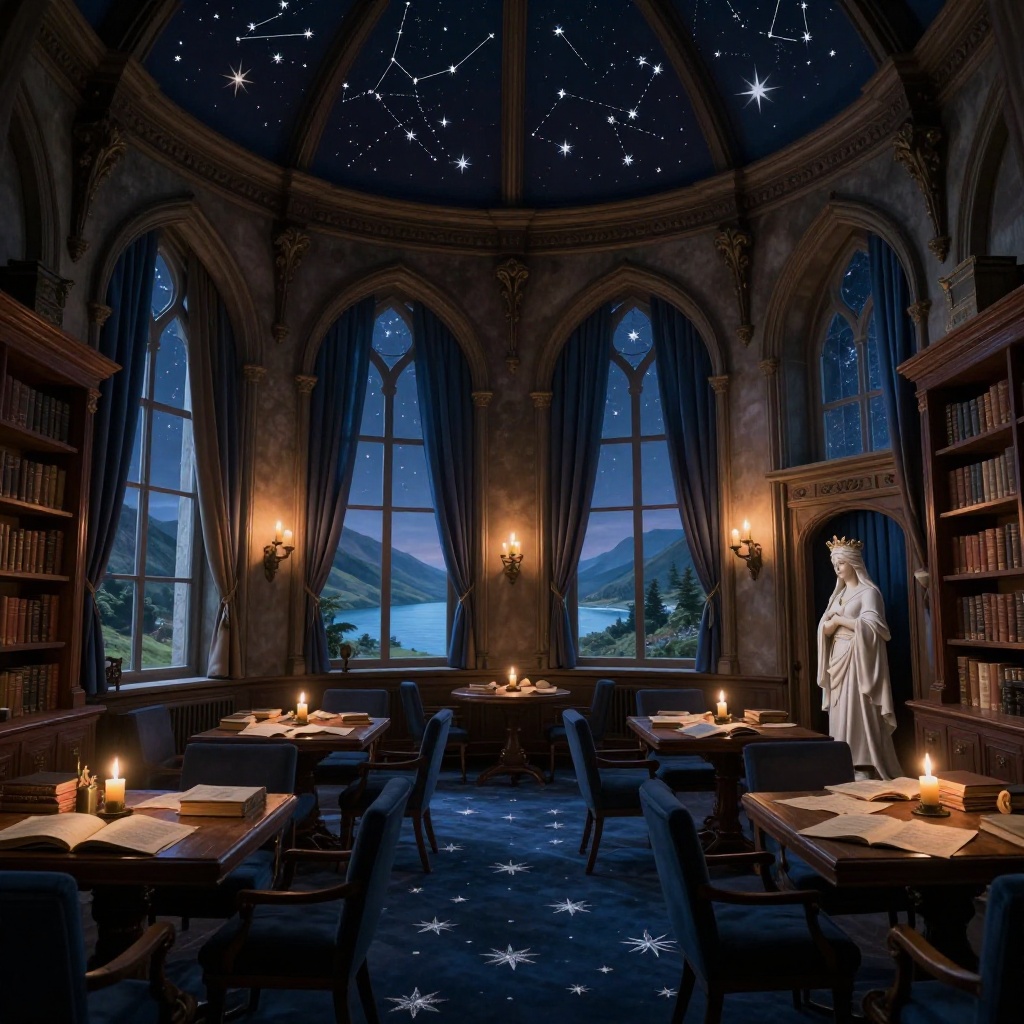
Passing the eagle knocker, one steps into a wide, circular chamber under a graceful domed ceiling painted with stars. By day, sunlight pours in through arched windows draped in blue and bronze silks, offering stunning views of the Hogwarts grounds – the Great Lake, the Forbidden Forest, the Quidditch pitch, and distant mountains. By night, the ceiling’s painted constellations mirror the sky, echoed by a midnight-blue carpet patterned with stars. The airy space is filled with tables, comfy chairs, and rows of bookcases, essentially an in-room library for studious Ravenclaws. It’s not uncommon to see books left open on tables or students quietly studying into the night under lantern light. The ambience is serene and scholarly – truly a “perfect place for studying” as the official description notes.
Notably, a white marble statue of Rowena Ravenclaw stands beside the door leading up to the dormitories. In the statue, Rowena wears a stone replica of her diadem upon her head, reminding students to prize wisdom above all. The dormitories themselves branch off from the common room, with comfortable four-poster beds covered in sky-blue silk quilts and more arched windows where the wind whistles soothingly at night. Many Ravenclaws claim that the sound of the wind around the tower lulls them to sleep, and that no other house has such “stunning views” or pleasant white noise.
Living in Ravenclaw Tower does come with one mild inconvenience: you must exercise your brain to get in. The eagle’s riddles range from philosophical (“Which came first, the phoenix or the flame?”) to whimsical. (For the record, the answer to that riddle was: “A circle has no beginning,” which earned Luna Lovegood a nod of approval from the knocker.) Another famous example: “Where do vanished objects go?” to which Professor McGonagall answered, “Into non-being, which is to say, everything.” There’s no shy way to sneak into Ravenclaw Tower – you either solve the riddle or wait. On occasion, a stumped Ravenclaw might be found camping on the corridor floor if a riddle completely befuddled them! But such incidents are rare and often become a source of humor (and motivation to study harder). Overall, the Ravenclaw common room experience is one of mental stimulation and aesthetic beauty – a true haven for those who love to ponder while gazing at the stars.
Notable Ravenclaw Alumni and Their Achievements
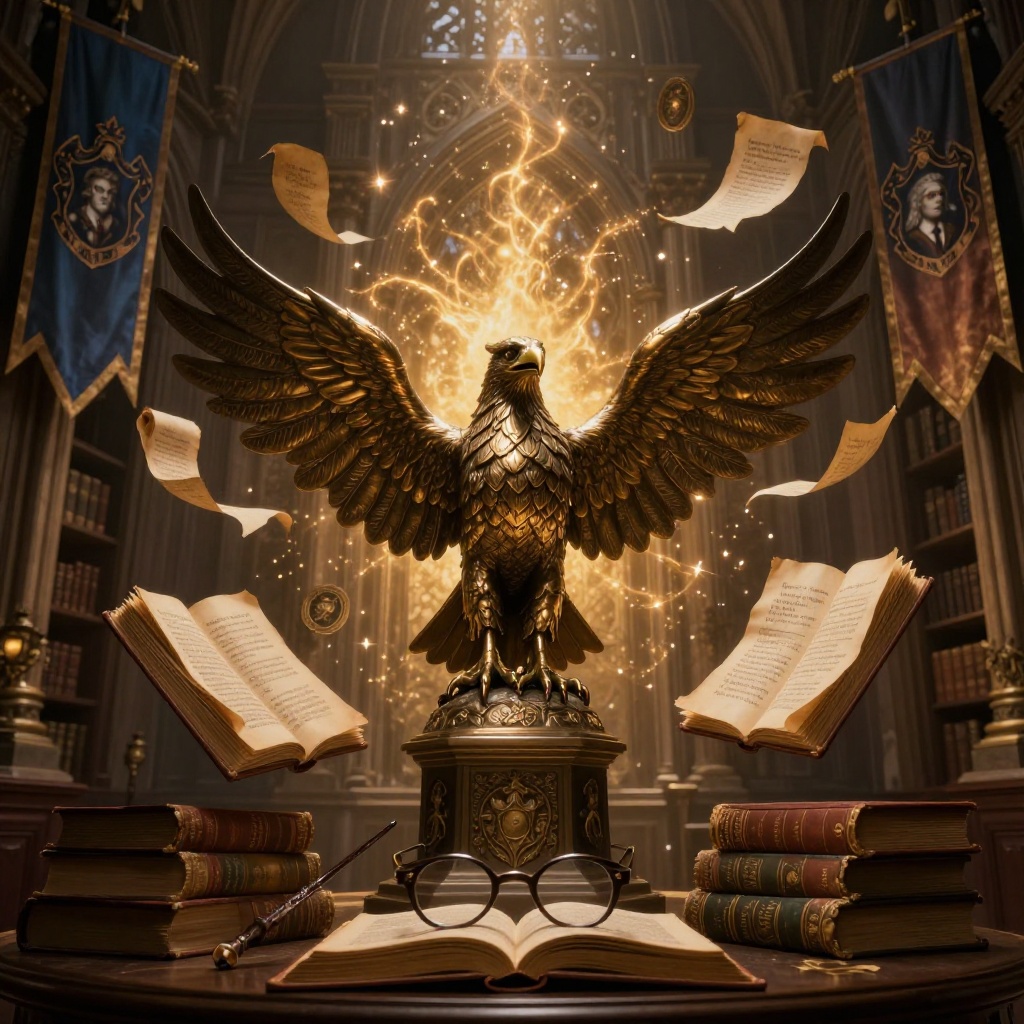
Ravenclaw’s emphasis on intelligence has produced wizards and witches of great renown in many fields. Below is a list of some famous (and infamous) Ravenclaws through the ages, and the achievements that make them stand out:
- Rowena Ravenclaw (10th century): One of the four Hogwarts founders, celebrated for her brilliance and creativity. Rowena is credited with naming Hogwarts (after dreaming of a warty hog) and conceiving its ever-changing layout. Her legacy includes Ravenclaw House’s values and the enchanted diadem said to grant wisdom.
- Helena Ravenclaw “The Grey Lady” (Founders’ era): Rowena’s daughter and the house ghost of Ravenclaw. In life, Helena secretly stole her mother’s wisdom-bestowing diadem out of envy. After her tragic death at the hands of the Bloody Baron, she returned as the Grey Lady ghost, guarding her secret until it aided Harry Potter in locating the lost diadem Horcrux.
- Ignatia Wildsmith (1227–1320): A medieval Ravenclaw witch famed as the inventor of Floo Powder, the magical powder that enables travel via fireplaces. Thanks to Wildsmith’s clever creation (whose formula remains a closely guarded secret), witches and wizards have been zipping through chimneys for centuries.
- Laverne de Montmorency (19th century): A pioneering potioneer who invented a series of advanced love potions in the 1800s. Her work is still studied in N.E.W.T.-level Potions classes. Ravenclaws proudly claim her innovations in amortentia and other potions as examples of their house’s ingenuity.
- Millicent Bagnold (1910–1990): A Ravenclaw who served as Minister for Magic from 1980 to 1990. She is best known for presiding over the wizarding world during Voldemort’s first downfall in 1981. Upon Harry Potter’s miraculous survival, Bagnold defied the International Statute of Secrecy by declaring, “I assert our inalienable right to party,” allowing nationwide celebrations. This bold decision, and her capable leadership, made her a celebrated figure.
- Garrick Ollivander (b. 1907): The esteemed wandmaker of Diagon Alley, widely regarded as the finest wandmaker in the world. A proud Ravenclaw alumnus, Ollivander’s genius lies in pairing wand cores and woods to the perfect wizard. He has crafted wands for decades of Hogwarts students (including Harry’s) and his depth of knowledge on wandlore is unparalleled.
- Filius Flitwick: Head of Ravenclaw House during Harry Potter’s era and the longtime Charms Master at Hogwarts. Professor Flitwick is a diminutive wizard part-goblin in heritage, known for his cheerful demeanor and extraordinary skill. A former dueling champion in his youth, Flitwick trained generations of students in the art of Charms (Wingardium Leviosa, anyone?) and played a key role in the defense of Hogwarts during both Wizarding Wars.
- Sybill Trelawney: The quirky Divination Professor at Hogwarts, and another proud Ravenclaw. Though often doubted for her sherry-induced prophecies, Trelawney made at least two genuine prophecies that dramatically shaped wizarding history – including the prophecy of “the one with the power to vanquish the Dark Lord,” which foretold Harry Potter’s role in Voldemort’s fate. Her presence in Ravenclaw highlights the house’s acceptance of those with unconventional talents.
- Quirinus Quirrell: The Defense Against the Dark Arts professor in Harry’s first year, who (to everyone’s shock) was a Ravenclaw alumnus. Bookish but timorous, Quirrell took a “grand tour” of the world after graduation to gain experience – unfortunately falling in with Voldemort. He returned to Hogwarts secretly hosting the Dark Lord on the back of his head, proving that even a learned Ravenclaw can be led astray. His tenure ended ignominiously (as did his life) when Harry foiled his attempt to steal the Philosopher’s Stone.
- Gilderoy Lockhart: A flamboyant celebrity author and fraud who was sorted into Ravenclaw. Despite earning Witch Weekly’s Most-Charming-Smile Award and writing a stack of bestselling adventure books, Lockhart’s “achievements” were built on memory charms and stolen credit. As a Hogwarts professor, his narcissism and incompetence provided a cautionary tale – he ultimately wiped his own memory with a backfiring charm. Still, Lockhart did demonstrate above-average intelligence (if not ethics) and remains one of Ravenclaw’s most famous failures. In the end, he taught students “how not to behave,” as a Wizarding World retrospective wryly noted.
- Moaning Myrtle (Myrtle Warren): A Muggle-born Ravenclaw student in the 1940s, remembered chiefly for becoming a ghost after her untimely death. Myrtle was miserable at Hogwarts, bullied by peers – until the day she was killed by the Basilisk released from the Chamber of Secrets. She haunted the girl’s bathroom where she died, earning the nickname Moaning Myrtle. Though not a success story in life, Myrtle’s ghost later helped Harry and friends solve the mystery of the Chamber, proving that even the overlooked Ravenclaw had a role to play.
- Luna Lovegood: Perhaps the most beloved Ravenclaw of Harry Potter’s generation, Luna is an open-minded and brave witch who helped Harry form Dumbledore’s Army and fought at the Battle of Hogwarts. Her wildly creative outlook (she once sported a hat adorned with a live lion’s head to support Gryffindor Quidditch) and unwavering loyalty made her “one of the best friends anyone could wish for”. After the war, Luna became a renowned wizarding naturalist, discovering and classifying many magical species. She epitomizes the independent thinking and kindness that Ravenclaws admire.
- Cho Chang: A talented Quidditch Seeker for Ravenclaw and a popular student in the 1990s. Cho was known for her athletic skill and was sought after as a date (famously Harry’s first crush). She bravely joined Dumbledore’s Army to oppose Umbridge, and though her friend’s betrayal caused a rift, Cho returned to fight in the final battle at Hogwarts. In doing so, she proved true to Ravenclaw’s courage and intellect.
- Xenophilius Lovegood: Luna’s father, an eccentric Ravenclaw alumnus and the editor of The Quibbler magazine. Xeno’s imaginative approach to journalism (printing stories on creatures and conspiracies few believe) shows the Ravenclaw flair for thinking outside the box. He famously published Harry’s interview about Voldemort’s return in The Quibbler, helping turn the tide of public opinion. Though he faltered under threat (temporarily betraying Harry to save Luna), Xenophilius remains a symbol of Ravenclaw individuality taken to its most colorful extreme.
These are but a few of the notable Ravenclaws who have left their mark. The house’s alumni also include multiple Ministers for Magic (aside from Bagnold, e.g. Lorcan McLaird in the 1920s and Hector Fawley in the 1930s were Ravenclaws), at least one Hogwarts headmaster/headmistress (Niamh Fitzgerald in the 15th century and Basil Fronsac in the 19th), and innumerable scholars, inventors, healers, and creatives. From the battlefield to the bookstore, Ravenclaws have contributed knowledge and innovation to the wizarding world in every era.
Are you more like Luna, Ollivander, or Cho Chang? Take the Character Quiz to discover which Harry Potter character matches your personality.
Ravenclaw in Famous Hogwarts Events
Throughout Hogwarts history, Ravenclaw House and its members have played key roles in many significant events. Here’s a timeline of important moments involving Ravenclaw:
- c. 993 A.D. – Hogwarts is Founded: Rowena Ravenclaw helps establish Hogwarts, selecting students who value wit and learning. She likely named the school and chose its cliffside location after the vision of a hog in her dreams. The four founders create the house system, and Rowena’s ideals shape Ravenclaw’s identity from the start.
- c. 994 A.D. – Salazar Slytherin Departs: A rift among the founders occurs when Salazar Slytherin insists Hogwarts should exclude Muggle-born students. Rowena Ravenclaw and the others reject this idea, defending the inclusion of all magical children. Tensions rise until Slytherin leaves the school permanently, an event that sets the stage for future lore (like the Chamber of Secrets). Ravenclaw House, with its many Muggle-borns, stands firmly on the side of tolerance and knowledge for all.
- 11th Century – The Lost Diadem and Helena’s Betrayal: During this era, Rowena’s daughter Helena Ravenclaw steals her mother’s diadem and vanishes abroad. The diadem’s disappearance is a secret Rowena keeps even from her fellow founders, and it becomes a legendary “lost treasure” of Hogwarts.
- 11th Century – Helena Ravenclaw’s Death: Shortly after, the Bloody Baron tracks Helena to Albania. When she refuses to return, he kills her in a crime of passion and then kills himself. Their ghosts soon haunt Hogwarts – Helena (the Grey Lady) in Ravenclaw Tower and the Bloody Baron in the dungeons – marking the only time two house ghosts are intertwined by tragedy.
- 1943 – Moaning Myrtle’s Demise: Myrtle Warren, a young Ravenclaw student, is killed by the Basilisk unleashed from the Chamber of Secrets. Her death prompts the castle’s temporary closure and Tom Riddle’s “Special Award for Services” (for ostensibly “catching” the culprit). Myrtle’s ghost remains to haunt the second-floor girls’ lavatory, where decades later she provides a crucial clue about the Basilisk to Harry. This event ties Ravenclaw to the dark legend of Slytherin’s Chamber.
- c. 1945 – Tom Riddle Finds the Diadem: While still a student, Tom Riddle befriends the Grey Lady ghost and learns the location of Ravenclaw’s lost diadem. He travels to Albania, retrieves the diadem, and later uses it to create his Horcrux. The diadem is hidden in the Room of Requirement at Hogwarts – unbeknownst to anyone – for over half a century. This moment quietly links Ravenclaw’s relic to Voldemort’s rise.
- 1994 – The Triwizard Tournament: During the Triwizard Tournament, Hogwarts unites to support its champion Cedric Diggory (of Hufflepuff). Many Ravenclaws, like the rest of the school, cheer Cedric and are skeptical of Harry’s unexpected entry. In fact, “most Ravenclaws supported Hufflepuff champion Cedric Diggory,” believing Harry might have cheated to get in. This causes some inter-house tension, as even Cho Chang initially wears a “Potter Stinks” badge in jest. However, after Cedric’s tragic death, Ravenclaws join the school in honoring his memory.
- 1995 – Dumbledore’s Army: In Harry’s fifth year, Dumbledore’s Army is formed to secretly teach real Defense Against the Dark Arts. Ravenclaw students are instrumental in the DA’s ranks – notably Luna Lovegood, Cho Chang, Padma Patil, Terry Boot, Anthony Goldstein, and others attend the clandestine meetings. Their participation shows Ravenclaws’ willingness to fight tyranny with knowledge. (However, one Ravenclaw, Marietta Edgecombe, infamously betrays the DA to Professor Umbridge, motivated by fear and her mother’s Ministry position. Marietta’s betrayal, resulting in a face full of Sneak pimples, is a rare dark mark on Ravenclaw’s record.)
- 1997 – Battle of the Astronomy Tower: While this battle mostly involves Gryffindors and Death Eaters, one Ravenclaw student – Luna Lovegood – is part of the ambush that fights the intruders in Half-Blood Prince. After this, Luna is abducted (in early 1998) due to her father’s anti-Ministry stance, showing Ravenclaws were not spared the dangers of Voldemort’s regime.
- May 1, 1998 – Incident in Ravenclaw Tower: On the eve of the Battle of Hogwarts, Death Eater Alecto Carrow lies in wait in the Ravenclaw common room to capture Harry. Harry and Luna venture to Ravenclaw Tower seeking the diadem, only to be ambushed by Carrow, who presses her Dark Mark to summon Voldemort. In the scuffle, Luna swiftly stuns Alecto unconscious. Moments later, Professor McGonagall and Alecto’s brother arrive; after a confrontation (in which McGonagall heroically duels and subdues the Carrows), the alarm is raised for the final battle. This intense altercation literally in the Ravenclaw common room highlights the house’s direct involvement at the start of the war’s climax.
- May 2, 1998 – Battle of Hogwarts: During the ultimate battle, Ravenclaw students, alumni, and staff stand with their school against Voldemort. Professor Flitwick leads dueling efforts (he is seen dispatching Death Eater Antonin Dolohov). Cho Chang returns as part of the reinforcements from Hogsmeade. Padma Patil and Terry Boot fight bravely among the defenders. When Pansy Parkinson of Slytherin attempts to turn Harry over to Voldemort, the Ravenclaws (along with Hufflepuffs and Gryffindors) instantly raise their wands against her in Harry’s defense. Meanwhile, Harry, with Luna’s help, locates Ravenclaw’s diadem Horcrux in the Room of Requirement. It’s ultimately destroyed by Vincent Crabbe’s Fiendfyre, which Harry notes as the destruction of Rowena’s treasured artifact. By the battle’s end, Ravenclaw has contributed significantly to Voldemort’s defeat – through knowledge (the diadem clue), combat, and courage.
- 2010s – Later Achievements: In the post-war era, Ravenclaws continue to shine. Luna Lovegood becomes a famous Magizoologist. Some years on, Professor Filius Flitwick is still at Hogwarts, happily imparting wisdom. And in a new generation, the Sorting Hat continues to sort quick-minded first-years into Ravenclaw, ensuring the cycle of wisdom carries on.
Myths, Trivia, and Fan Theories about Ravenclaw
Beyond the established canon, Ravenclaw House has accumulated various lesser-known facts, fan theories, and bits of trivia that fans love to discuss. Here are some intriguing ones that deepen our appreciation of Ravenclaw:
- Rowena’s Naming of Hogwarts: A popular legend holds that the very name “Hogwarts” came to Rowena Ravenclaw in a dream. In this dream, a warty hog led her to a lakeside cliff – inspiring not only the school’s location but its whimsical name. This myth exemplifies Rowena’s imaginative mind and is a favorite tidbit among lore enthusiasts.
- Why an Eagle, Not a Raven?: Many new fans assume Ravenclaw’s symbol should be a raven (understandably!). However, the house mascot is an eagle, representing the element of air and the sky’s expanse. The very name “Ravenclaw” is believed to derive from Rowena’s family name rather than the bird. According to Wizarding World lore, the eagle on the crest “represents intelligence and wisdom” – it “soars where others cannot climb.” The bronze eagle against a blue sky background on the crest underscores this association with air and intellect. (Fun fact: an early rejected sketch of the Ravenclaw crest was later repurposed to design the logo of the Montrose Magpies quidditch team!)
- Elemental Alignment: Each Hogwarts house is linked with a classical element: Ravenclaw is Air, fitting for a house high in a tower and devoted to the airy pursuits of the mind. Blue and bronze were intentionally chosen – blue for the sky, bronze for eagle feathers – to reflect this element. Accordingly, Ravenclaws are often associated with traits of air: intelligence, independence, and creativity.
- The Riddle Ritual: Ravenclaw is unique in requiring students to answer a riddle to enter their dormitory. This has given rise to jokes and theories – for instance, do teachers ever get locked out? (McGonagall proved at least some non-Ravenclaws can solve the riddles easily.) Fans also note this means there’s no “forced loyalty” in keeping the door password secret – anyone smart enough can get in, theoretically. However, the Sorting Hat did hint that logic is a rare gift among wizards, so Ravenclaw’s security-by-puzzle is usually effective. The practice also reinforces a mini culture of sharing knowledge – Ravenclaws often discuss past riddles and their answers, sharpening each other’s wits.
- Hatstalls and Near-Ravenclaws: Over the years, a few characters fans know well were almost sorted into Ravenclaw. The most famous example is Hermione Granger – the Sorting Hat “seriously considered” placing her in Ravenclaw due to her prodigious intellect. (Ultimately, Hermione’s daring and loyalty put her in Gryffindor, but she has many Ravenclaw-like qualities.) Minerva McGonagall was another Hatstall split between Gryffindor and Ravenclaw, which is no surprise given her scholarly talent. These cases show that intelligence alone doesn’t define a person – values and choices do – but Ravenclaw was a close call for some of Hogwarts’ brightest heroes.
- Eccentrics Welcome: There’s a saying among some fans: “Ravenclaw is the house of misfit geniuses.” Indeed, the house has a reputation for nurturing eccentrics. Xenophilius and Luna Lovegood (father and daughter) are prime examples of Ravenclaw open-mindedness toward the odd and extraordinary. Another is Uric the Oddball, whose bizarre antics are almost folkloric. Far from being shunned, these individuals often find acceptance in Ravenclaw, showing the house’s appreciation for individuality. As Luna herself said, “Wit beyond measure is man’s greatest treasure,” and sometimes wit means seeing the world very differently.
- The Grey Lady’s Secretive Nature: Until Harry Potter finally coaxed her story out, the Grey Lady never willingly told any student about her past – a mystery that endured for centuries. Some fans theorize that Helena might have occasionally guided particularly astute Ravenclaws to lost items or offered cryptic advice, but in general she kept aloof. This feeds a fan theory that Rowena’s ghost might also exist in some form (perhaps via a portrait or magical imprint) and that Helena’s silence was partly out of guilt toward her mother. While no canonical evidence of Rowena’s ghost exists, the Ravenclaw common room does feature a beautiful portrait of Rowena that in Hogwarts Mystery (a wizarding world game) can offer history lessons. Whether mere legend or not, the mother-daughter dynamic of Ravenclaw’s founder and ghost fascinates many – a tale of pride, forgiveness, and lingering regret.
- Rowena’s Broken Heart: It’s often said that Rowena Ravenclaw died of a broken heart. Fans debate whether this is purely metaphorical or if Rowena’s grief was amplified by some magical malady. In any case, the idea that emotional pain contributed to her death adds a tragic, human dimension to a figure often idealized for her intellect. Rowena’s greatest tragedy – her estrangement from Helena – reminds Ravenclaws that wisdom and love must go hand in hand. This legend also parallels the fate of another great witch (Helga Hufflepuff), showing that even the wisest are not immune to heartbreak.
- Ravenclaws and Dark Wizards: Interestingly, Ravenclaw has produced notably few Dark Wizards compared to some other houses. No Ravenclaw Death Eaters are mentioned by name in the books. (Even Voldemort’s devoted followers were primarily from Slytherin, with a sprinkle of others, but none confirmed from Ravenclaw.) The two most infamous “dark” Ravenclaws are arguably Quirrell (who wasn’t so much evil as possessed and manipulated) and Lucinda Talkalot – okay, we made her up, because there really aren’t many! Some fans theorize that Ravenclaw’s emphasis on logic and wisdom might inoculate against the irrational hatred that fuels Dark wizards, or perhaps that their individualism makes them less susceptible to following a demagogue. Regardless, Ravenclaws can take pride that their house’s legacy is largely on the side of light. Even Gilderoy Lockhart’s misdeeds were selfish careerism rather than alliance with evil.
- House Pride and Pop Culture: In the wizarding world, Ravenclaw’s reputation often takes a backseat to Gryffindor’s heroics or Slytherin’s infamy, but fans have reclaimed Ravenclaw pride. A thriving community of Ravenclaw fan clubs share house-related jokes like “Ravenclaw: doing your homework for fun since 993!” and design creative eagle-themed merch. The fact that Luna Lovegood became a fan-favorite character has boosted Ravenclaw’s profile immensely. Even in-universe, Ravenclaws have a bit of an image as quirky intellectuals – a 1980s Hufflepuff memoir humorously notes getting in trouble for dueling a Ravenclaw prefect who bragged too much about a famous witch being from his house. It seems every now and then, Ravenclaws need reminding to be humble!
- The House Ghost’s Insight: A final neat piece of trivia: the Grey Lady’s “hobby” is listed as keeping secrets. This tongue-in-cheek fact comes from a Rowling-approved source and perfectly suits Helena’s character. It also makes one wonder, what other Hogwarts secrets might the Grey Lady know? Some fan theories suggest she could reveal hidden rooms or clues if she chose – perhaps a story for another day.
In summary, Ravenclaw House is far more than just the “smart house.” Its history is woven with creativity, tragedy, triumph, and mystery. From the quiet wisdom of Rowena to the wild imagination of Luna, Ravenclaw’s story continues to captivate fans who value knowledge and originality.
Conclusion: Ravenclaw’s Enduring Enigma
Ravenclaw may not always seize the spotlight in Hogwarts’ tales, but its influence is undeniable. The house founded by a scholarly witch has given us inventors and ministers, seers and heroes. Its common room has been a haven for free-thinkers and a setting for key turning points in wizarding history. Its emblem – the eagle – still soars as a reminder that “wit beyond measure” truly is life’s greatest treasure.
For fans and newcomers alike, Ravenclaw represents the magic of the mind. It teaches us that curiosity and creativity are as heroic as bravery, that wisdom and love must balance, and that there’s always value in asking the next riddle. Whether you’re a proud Ravenclaw or just Ravenclaw-at-heart, the house’s rich history and lore offer endless inspiration to learn, dream, and dare to be different – just as Rowena Ravenclaw intended so many years ago.
Discover Your Place in the Wizarding World
Now that you know the full history of Ravenclaw House, it’s time to find out where you truly belong. Does the eagle call to you, or will the Hat surprise you?
Take the Sorting Hat Quiz Now →
Explore more of the wizarding world:
Related Reading

History of Hufflepuff House: From Helga's Legacy to Modern Heroes
Hufflepuff is often known as the Hogwarts house of loyalty, kindness, and hard work – but its history and legacy are far richer than many realize. From its founding by the kind-hearted Helga Hufflepuff in medieval times to its modern-day portrayals in games like Hogwarts Legacy, Hufflepuff House has an inspiring story of inclusivity and quiet heroism.
Read more
History of Slytherin: The Cunning Legacy of Hogwarts' Most Notorious House
Discover the rich history of Slytherin House from its founding by Salazar Slytherin to its cultural impact today. Explore its traits, famous members, evolution, symbolism, controversies, redemption stories, and popular fan theories in a conversational deep dive for Harry Potter fans.
Read more
History of Gryffindor: From Godric to Harry Potter
Explore Gryffindor’s history from founder Godric’s ideals of bravery to Harry Potter’s legacy – plus house lore, rivalries & fan theories.
Read moreDiscover your magical identity